Showing posts with label scott westerfeld. Show all posts

Tuesday, September 18, 2012

Steampunk Tuesday - Anachronisms or You can DO that??

Steampunk laptop:  You can DO that???


First off, I have to say, I love the word "anachronism".  By which I mean, not just, "Dude, that's a sweet word with an awesome definition."  I mean I love the word.  I love saying it. Say it out loud to yourself, right now. It's a fantastically chewy word. One where you really have to enunciate each syllable or you run the risk of tripping over yourself.

Yeah. I really like saying that word.

Second.

You may recall a while ago I finally broached the subject of why I, Adrienne Kress (yes, I am Adrienne Kress) love Steampunk. I had a nice list. Said list is here.

And the first, or rather sixth but technically it was meant to mean first, reason why I love Steampunk is Douglas Adams. That is to say my love of absurdity.  That is to say my love of mixing things together that never could possibly actually be mixed together in real life.  That is to say my love of, "You can DO that??"

So today I thought I'd elaborate on my number one, or rather number six, reason why I love Steampunk. And that's when we get to say, come on, all together now:

Anachronism.

If I was in highschool the next thing I'd say is:

The Webster's Dictionary defines Anachronism as:

1: an error in chronology; especially : a chronological misplacing of persons, events, objects, or customs in regard to each other 
2: a person or a thing that is chronologically out of place

Now if that isn't Steampunk I don't know what is.

The idea that one can set a story in the past but include all manner of things that never existed back then is just so totally mind-blowingly amazing to me.  You see, it's fiction.  It's all fake.  So . . . why not?  Why not just play with what does and doesn't belong in stories? 

I just love that.  I love the person who first thought outside the box like that.  It makes so much sense to me.  And it's also totally ridiculous.  Which makes it all the more amazing.

I love also seeing the problem solving involved in it.  The creativity, e.g.: how do I invent a means to travel to the moon using the technology of the time?  Scott Westerfeld is utterly brilliant at the how.  I love the humour, reading a description and then realising that what the author is sharing with us as seeming so foreign is actually working towards the reveal that what is being described is, say, a cell phone.  

I love how a society that shouldn't have any relationship with futuristic technology can be so laissez-faire about it: "So tomorrow morning I shall be taking the dirigible to Cambridge, that is, of course, unless you need it."  

I also like how one can be not only anachronistic with props and costumes and set pieces, one can be anachronistic in attitudes and behaviour.  One can explore race and gender issues, bring them to the surface with far more ease than in a purely historical novel.  Play with what ifs, not be constrained by what happened in the historical timeline but speculate how the timeline might have been different.


And then there's voice.  I mean the voice in which the novel itself is written.  And something that I have wanted to write about for a while: my own process at finding the voice for THE FRIDAY SOCIETY,  which I think is perfect for this subject because the voice I chose is inherently anachronistic.

So . . .

Aside from all of the above, I decided to play with with the voice of the book itself.  Now this hadn't always been my intention.  In the beginning I wrote my proposal for TFS in a lovely oldy-timey voice.  But it just wasn't working.  My editor Nancy and I were going back and forth trying to figure out why that was, and I was getting kind of frustrated. So in a rebellious mood I just re-wrote the scene in an entirely contemporary voice. And then I read it over. And I kind of liked it. And then . . . then I had a thought: "Maybe I'm approaching this wrong. Maybe the voice doesn't need to be constrained by the time period."

And then I had a nice montage flash through my brain ("This is a montage!") of works of fiction that had given me "You can DO that??" moments when it came to voice. I'm talking Sofia Coppola's MARIE ANTOINETTE, and even A KNIGHT'S TALE (which I felt didn't 100% work, but not due to the voice, so I still use it as an example). Even DEADWOOD, which seems on the surface like it stayed true to period, doesn't entirely.  The writers realised they couldn't use the swear words of the day because they sounded too cheesy and so stuck with the tried and tested F word (not that that word didn't exist back then, but it wasn't used in the same way as we use it now. It really did mean what it meant, it wasn't just used as an expression of frustration).

There was also a translation of CYRANO DE BERGERAC I had seen staged once that modernised some of the slang and swearing (while still keeping the heightened language) that I loved so much, I bought the play.

These were films/television/plays set in the past but with a contemporary flare. The attempt was to demonstrate a relatability, I think, to show that things back then in some ways could be considered similar to now. Marie Antoinette was akin to Paris Hilton. Only you know, with bigger dresses and more beheading.

I remembered too the first time I encountered it and had a good think about it. How, I realised, while we have some examples of casual everyday speech from the past, and delightful lists of slang, most of the source material we average non-linguistics major Joes use to create conversations set in the past is the literature or theatre of the past. And that that language is a heightened form of writing. It isn't actually representative of how people necessarily spoke every day (though I'm sure some people did, Oscar Wilde for example). It's like people saying that people today all speak like Aaron Sorkin screenplays, or the Gilmore Girls.

So when we emulate the literature of the past in our own, we aren't emulating how people actually spoke. We are emulating how the writers of the past represented how people of the past spoke.

Basically my realisation was: it's not verisimilitude. Despite that period's interest in verisimilitude (can you tell I was a theatre major and studied WAY too much about the history and development of that subject, oy . . . ). Now this isn't to say I don't enjoy a good period piece. I in fact adore a good period piece. And that I don't enjoy the voice myself. Anyone who has read my short story in CORSETS & CLOCKWORK will see that I really do.  It's just it made sense with TFS to write it in a contemporary voice.  It seemed more true to the story I was telling.  It suited the fun, cheeky and, to borrow a word from my back cover copy, irreverent tone of the book.

But that's not all.

Say it with me now . . .

Anachronism.

YES! It all comes back to "You can DO that??" Because why not?  If I'm writing a book that already isn't true to period, with little anachronistic details like jet packs and steam carriages and crazy weaponry, why can't the medium itself be anachronistic?  Why not write a book set in the past, but with a contemporary voice? The whole darn book itself is steampunk! Dude! Woah!

So that's how the voice came to be.


Wow, that was a bit longer than I anticipated.  But I think it demonstrates how much I enjoy anachronisms.  And I guess not just saying the word.  But the definition itself.

But I still also really do love saying that word.

Anachronism. :)


And thus begins my series on Adrienne's Detailed Analysis of Why She Loves Steampunk.  Next week I shall move onto the number two, by which I mean five, reason I like Steampunk:  My love of SF/Fantasy.

But until then . . .  I ask all my lovely Steampunkers, what are some the coolest anachronistic moments you've seen or read in a Steampunk creation?  

Thursday, January 05, 2012

In Which I Express My Love For Book Covers


 I have a thing for covers.

I think most people who love books do.

Yes we also know not to judge books by them.

But we also do.

I love covers. I go into bookstores not to check out what the latest releases are about, but what they look like. I go through the stacks not to discover some gem of a book that didn’t make it to table placement, but to discover some gem of a book cover.

And it’s not just the cover. Oh no.

It’s the packaging of the book itself. What is the cover made of, are the words embossed, is there foil? The way the back cover relates to the front, a gorgeous spine. How does each chapter start – is there a swoosh, an ink blot, a geometric pattern? Are there end plates?  How are the “parts” divided?


(This may be why I worry about ebooks taking over the world, I love books as art in and of themselves.)

I always check out an author’s new cover when she makes the announcement on her Twitter/Writing Forum/Blog. I frequent websites that analyse covers. I frequent designers’ websites.

This is currently my favourite blog about covers (of the YA variety).

I even designed the cover for a friend.

I love covers.

And I’m trying to figure out why.

A few weeks ago for no particular reason I shared some of my favourite works of art. I revealed I’d studied a fair bit of art history in University, and had a general passion for the subject. So clearly I love visual art. And covers are visual art.

But it’s not just that.

I think why I love covers best is that a cover artist/designer has to be creative but within a strict set of guidelines.

First of all the cover has to be a specific size.

Then a cover has to get across a wealth of information in a very limited space:

- Title
- Author
- Genre
- Tone
- And a little thing called Story

And sometimes a blurb has to find its way on there too.

I love that. I love that within a set of seeming rigid parameters so much originality can result. It’s the same way I feel about movies. Some of the best films happen through problem solving. The shark doesn’t work . . . I guess we’re not showing it then.  We have a small budget for a short film about aliens in South Africa? We’ll do it documentary style. That kind of thing.

I’ve always believed that the greatest innovations come out of problem solving. Being given free reign with a bottomless budget gives you The Phantom Menace.

Limitations make you think outside the box. Structure can make the imagination flourish. I have recently become quite interested in writing Shakespearean sonnets because of their rigid form. There is also something so satisfying about managing to surprise within the framework of something expected.

So too is it truly exciting to see a cover that seems wholly new and original but still does exactly what it is supposed to.  And it is also wonderful to see covers that pay homage to an old standard.

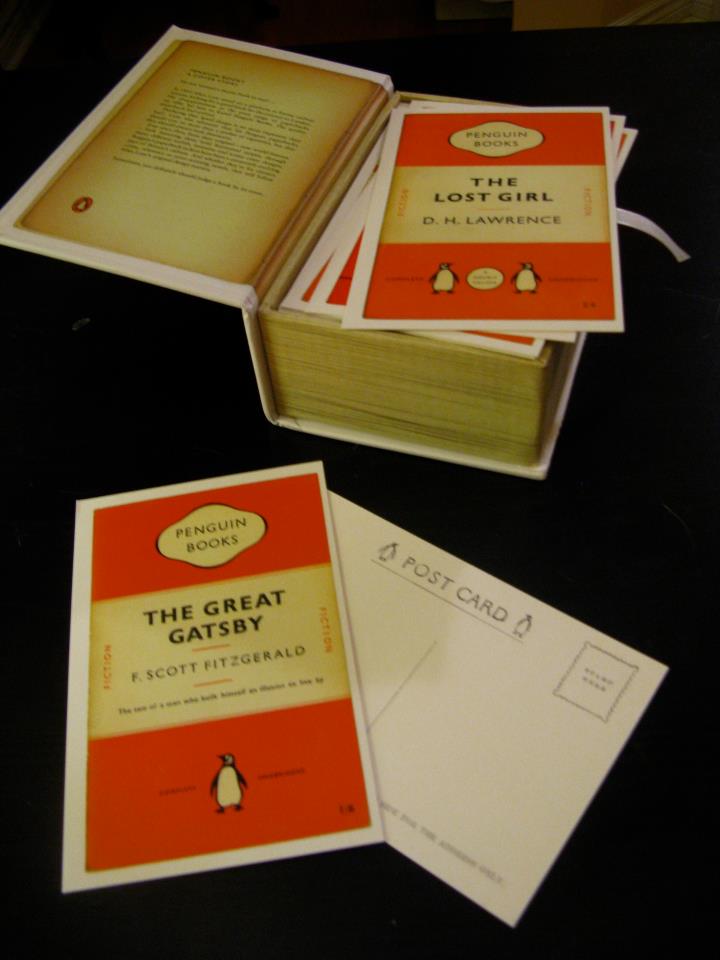
I also love this box of 100 classic Penguin book cover postcards I got from my publisher as a Christmas present:


I love the evolution of covers, what was popular in one decade and how that changes to the next, especially evident in reissued books.

And I wonder where covers will go now with the need to create covers that are easily identifiable as thumbnails.

It’s all so . . .cool.

Man.

I love covers.


Here are a couple recent YA covers that really struck me.  But of course, seeing as I love covers, there are many many more that I adore.  This is just a teeny tiny sample:


This book isn't out yet, the cover is courtesy of ThatCoverGirl's website.  Love!

Tuesday, November 08, 2011

Steampunk Tuesday - The Steampunk Scholar! aka Mike Perschon


So last week I featured a list of Steampunk books as recommended to us all by the Steampunk Scholar aka Mike Perschon.  And today, I am posting an interview he was so kind to do with me.  I met the fellow at the Canadian National Steampunk Exhibition and even sat on a panel with him.  The man's knowledge of Steampunk is impressive.  And it ought to be, considering he's doing his PhD on the subject.

But I digress.  Here's the interview.  Do check it out, I think his answers are just fantastic.

Here's his website:  SteampunkScholar.blogspot.com


What got you interested in Steampunk?

I’d heard the term in a few different contexts, but my current interest resulted from choosing a topic for my doctoral dissertation. I was either going to do Nine Inch Nails’ Year Zero as dystopic intertext, or steampunk. My Master’s advisor said, “Dystopia’s been done to death, and if you do steampunk, I’ll be your advisor again,” which really decided it, because we have a great working relationship.


You have a very specific definition of it, briefly what is it and how did you come up with it?

I speak about steampunk as an aesthetic that gets applied to other genres. The steampunk aesthetic combines a Industrial Era look or feel (neo-Victorianism) with a postmodern view of the past (retrofuturism) and technology that has the appearance of science, but none of the rigor we see in hard SF (technofantasy). Those three things, applied together, produce the look we call steampunk.


You are currently pursuing your PhD on the subject, what inspired you to do so and what is your end goal?

I was being pragmatic: I wanted to do something fresh, something that didn’t have a wealth of scholarship to compete with. Beyond that, it was a topic I could see myself being interested in for four to six years, which is the estimated length a literary doctoral degree takes to complete. My end goal is really just to get to get the PhD, settle into my work at Grant MacEwan University, and use the four months I get off every year to write fiction and spend the summer with my family.


What would you say is the most controversial topic within the Steampunk community?

The idea that the “punk” in steampunk constitutes a necessary political position, which I take umbrage with: there hasn’t been a hell of a lot of steam in steampunk, so why is it necessary to have punk? That’s not to say I’m opposed to oppositional politics in steampunk, but it’s exclusionary and somewhat pejorative to say that politically-themed writing is steampunk, and everything else is steampulp. Some of the best early steampunk, like Tim Powers’ Anubis Gates, would be steampulp by that rubric.


Does Steampunk hold any kind of "mirror up to nature" and if so, what does that mirror reflect do you think?

I think all texts are mirrors of the world, but steampunk’s mirror allows us to see the world with unexplored frontiers again, to respond to cynicism with romanticism, and engage in playful modes of writing, whether the writer’s agenda is serious or whimsical.


Where do you think Steampunk is heading? What is its future?

I really don’t know. I made some projections a year or so back, and they were largely correct, but I’m hesitant to prognosticate the future of a scene so big as steampunk. As far as the literature goes, my guess is that the future of steampunk is in space. And understand, I’m not saying I think that’s where it should go. It’s just that literary steampunk seems to be asking how to be the next big thing, and since zombies, vampires, fantasy, science fiction, superheroes, pirates, romance, and westerns have all been steampunked, it’s time to go into outer space. Or maybe inner space – given the roots in the nineteenth century, it’s interesting how few steampunk tales deal with Journeys to the Centre, outside Rudy Rucker’s Hollow Earth and a moment in Thomas Pynchon’s Against the Day.


Does it have staying power or is it just a fad?

Both. The hype generated by media exposure will die down, but there’s a dedicated core of people who dig steampunk in various ways who will keep the gears turning long past any mainstream popularity.


If there was only one Steampunk book you would recommend, what would it be and why?

It would really depend on who was asking, since I’ve read enough now to be able to ask a person their tastes, and approximate the best steampunk book to introduce them to the aesthetic. For academic big-heads, I’d say Thomas Pynchon’s Against the Day; for young adults, I’d say Scott Westerfeld’s Leviathan; and for people just looking to enjoy themselves, I’d say Gail Carriger’s Soulless.


You've been to many Steampunk cons, what's one of your favourite moments from those events?

I can’t do one, but I’ll give you three: receiving my goggles from Legion Fantastique, a Verne-improv group from San Francisco at my first con, reading from Soulless with Gail Carriger at Steamcon II in Seattle, and having Gary Gianni tell me I look like a young Orson Welles at Steamcon III.


Carriger and the Scholar reading.


What is your favourite personal Steampunk accessory?

I have a gorgeous leather slipcase for a writing pad that was given to me by good friends who accompanied me to some cons. It even underscores the aesthetic: the exterior slipcase has the steampunk look, while the interior is a regular coil-bound notebook. The illusion of steampunk, tucked under my arm. It goes to every con now: it’s the perfect accessory for a guy who calls himself a steampunk scholar.

Tuesday, November 01, 2011

Steampunk Tuesday - Books!

So I skipped a week of blogging due to being generally overwhelmed with work etc, but I'm back baby!

And what a perfect day to come back on, it's Steampunk Tuesday!  Sweet!


In a previous Steampunk Tuesday we did movies, and I thought it only right to do books this time around.  Because books are awesome.  And they also help us define further what Steampunk is. 

(Because I still maintain, though others disagree [which is cool, man, it's cool] that Steampunk has not exploded onto the scene quite yet.  My proof: my need to constantly define what it is.) 

At any rate.

I gots a couple lists for you.  But I gots to be upfront about them.  They aren't created by me.  Instead they are by the amazing Steampunk Scholar (interview with him coming soon): Mike Perschon.

If you ever felt that my attempts to define and dig into Steampunk were ever so slightly superficial, please check out his blog of awesome.  The guy's doing his PhD on the subject:  Steampunk Scholar.

I have mad respect for this guy, and I very much approve of his lists, so it felt a little silly recreating them when I could just give him the credit for them in the first place. 

Now he has a top ten list of his favourite Steampunk books (which I'll be posting at the bottom of this post), but I like it when he divides up the categories - simply for educational purposes.  If you want something more contemporary, or if you are looking for a classic, they are easier to find in this set of lists.


We begin with his Top Ten New Steampunk (2000 - 2009  <------ yes, this means the list is due for an update, but it's still a pretty great list):


  1. Against the Day by Thomas Pynchon
  2. Leviathan by Scott Westerfeld
  3. The Glass Books of the Dream Eaters by Gordon Dahlquist
  4. Alchemy of Stone by Ekaterina Sedia
  5. Fitzpatrick's War by Theodore Judson
  6. Skybreaker by Kenneth Oppel
  7. Boilerplate by Paul Guinan and Anina Bennett
  8. Perdido Street Station by China Mieville
  9. Soulless by Gail Carriger
  10. Whitechapel Gods by S.M. Peters

I feel a need to add the following mention as this book was listed 5th in our Scholar's Top Ten (as well as his Top Five for 2010) list but was published in 2010 - thus after the above list was created.  And that would be Cherie Priest's DREADNOUGHT:


Now we move onto his Top Five Classic Steampunk (1971-1999):


  1. The Anubis Gates by Tim Powers
  2. Anno Dracula by Kim Newman
  3. The Adventures of Langdon St. Ives by James Blaylock
  4. The Steampunk Trilogy by Paul DiFilippo
  5. The List of 7 by Mark Frost


And in case you are curious, here is the Scholar's Top Ten Steampunk Books:

  1. Against the Day by Thomas Pynchon
  2. Leviathan by Scott Westerfeld 
  3. Glass Books of the Dream Eaters by Gordon Dahlquist
  4. The Strange Affair of Spring Heeled Jack by Mark Hodder
  5. Dreadnought by Cherie Priest
  6. Alchemy of Stone by Ekaterina Sedia
  7. Fitzpatrick's War by Theodore Judson
  8. Skybreaker by Kenneth Oppel
  9. Anubis Gates by Tim Powers
  10. The Adventures of Langdon St. Ives by James P. Blaylock